Frequently Asked Questions
Common questions about the AI Assessment Scale, its implementation, and best practices for educators.
Understanding the Basics
What is the AI Assessment Scale (AIAS)? +
The AI Assessment Scale is a framework designed to guide the ethical and appropriate use of generative AI in educational assessment. Developed by Mike Perkins, Leon Furze, Jasper Roe, and Jason MacVaugh, it provides educators with a structured approach to integrating AI into their teaching practice.
The AIAS serves two key purposes: it is a communication tool that helps educators clearly articulate expectations to students, and it is a design framework that guides the redesign of assessments for the AI era. It is grounded in Vygotskian social constructivism and the concept of the Zone of Proximal Development.
What are the five levels of the AIAS? +
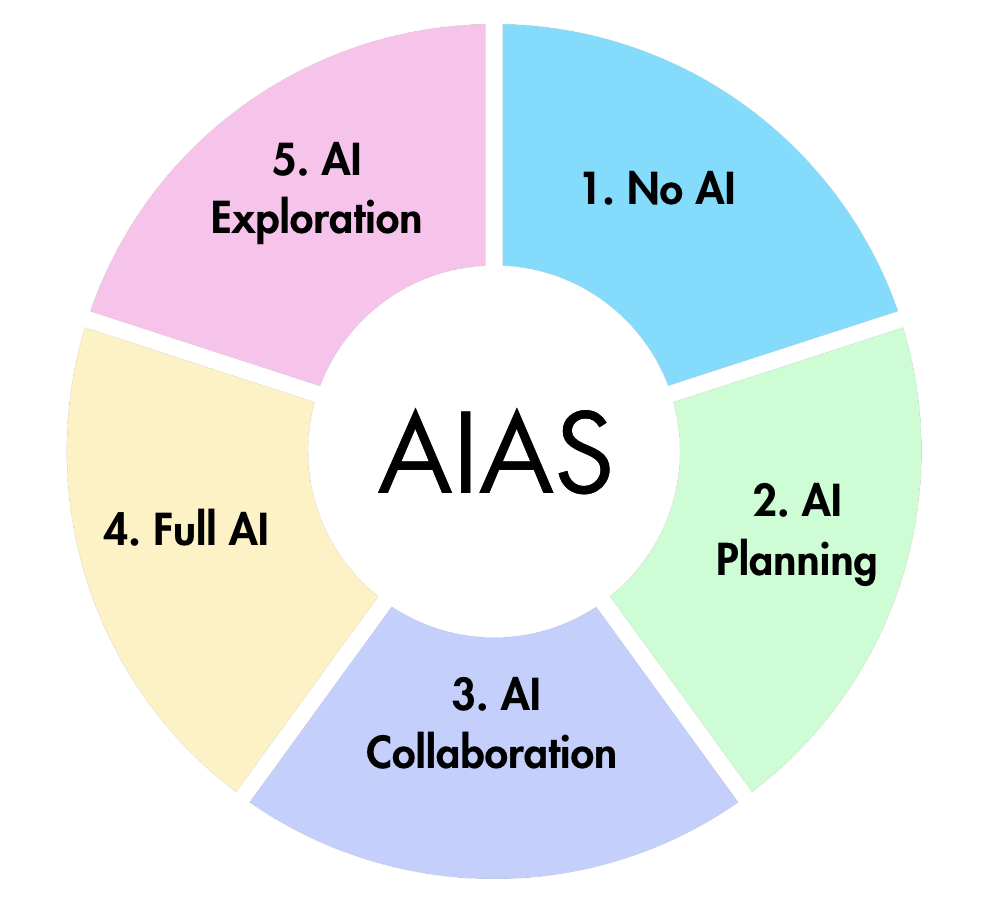
The AIAS consists of five levels, each representing a different degree of AI integration:
Important: These levels are non-hierarchical. No level is inherently “better” than another. The appropriate level depends on your learning outcomes, context, and what you are trying to assess.
Is the AIAS prescriptive? +
No. The levels are guiding rather than mandatory. The AIAS is published under a Creative Commons BY-NC-SA 4.0 license specifically to encourage adaptation to local contexts, disciplines, and institutional needs.
Think of the AIAS as a starting point for reform and conversation, not a rigid structure to be imposed. Educators are encouraged to adapt the framework to suit their specific teaching contexts.
How does the AIAS compare to the “two-lane” model? +
The AIAS and two-lane models serve complementary purposes.
The two-lane model focuses on security, distinguishing between environments where AI use can be controlled (Lane 1) versus where it cannot (Lane 2).
The AIAS focuses on design, providing guidance on how to structure tasks appropriately once you have determined your security context. Level 1 of the AIAS corresponds roughly to Lane 1, while Levels 2-5 operate within Lane 2.
Implementation
Can I just label my existing assessments with AIAS levels? +
This is a common mistake. Simply labelling existing assessments without redesigning them is ineffective.
Adding an AIAS level label without changing the task itself is a “discursive” change. Students tend to ignore labels that do not match task requirements. Effective AIAS implementation requires structural changes:
- Redesign the assessment brief to match your chosen level
- Update rubrics to reflect appropriate AI use
- Specify what evidence students must provide
- Create checkpoints that align with the level’s expectations
How do I choose the right AIAS level? +
Ask yourself these questions when selecting a level:
- What are the core learning outcomes I am trying to assess?
- Would the assessment still be valid if AI were used?
- Can I realistically enforce the restrictions I want to set?
- How does this fit within the broader programme of assessment?
- Do all students have equitable access to the required tools?
A key question to ask: “Is this a bad use of technology, or a bad use of your brain?” If AI use would undermine the skill you are trying to develop, consider Level 1 in a controlled environment. If AI is a legitimate tool in the profession, consider higher levels.
How should I handle equity and access issues? +
Equity is a critical consideration when implementing the AIAS:
- If your task requires GenAI tools, you must guarantee that all students have free access to appropriate tools
- Consider institutional subscriptions or design for freely available resources
- Be transparent about which tools are permitted
- Distinguish between AI tools and assistive technologies. Students requiring assistive technologies should not be disadvantaged
Remember that students from different backgrounds may have varying levels of AI literacy. Build in support and guidance rather than assuming prior knowledge.
Should AI policies be consistent across a programme? +
Yes. We strongly recommend standardising AIAS implementation within modules and across programmes. Inconsistent policies create:
- Validity issues when similar tasks have different rules
- Student confusion about expectations
- Difficulties in programme-level assessment mapping
Work at the faculty or discipline level to ensure coherent implementation. This “leading from the middle” approach has proven more effective than either top-down mandates or individual instructor decisions.
Understanding the Levels
Can I use “No AI” (Level 1) for take-home assignments? +
No. This is a common misconception.
There is no realistic way to ensure students do not use AI in unsecured environments. Level 1 should only be used in controlled environments where you can genuinely enforce the restriction:
- Supervised examinations
- In-class assessments with device restrictions
- Oral examinations or vivas
- Observed practical demonstrations
For take-home work, consider Levels 2-5 with appropriate structural design instead.
What is the difference between Level 3 and Level 4? +
Level 3 (AI Collaboration): AI assists with specific, defined tasks. Students critically evaluate and modify AI outputs. The student drives the work and maintains their own voice. Think of AI as a collaborator on particular elements.
Level 4 (Full AI): AI may complete any elements of the task. Students direct and orchestrate AI to achieve goals. The assessment evaluates how effectively students leverage AI as a tool. Think of AI as a capable assistant the student manages.
When should I use Level 5 (AI Exploration)? +
Level 5 is appropriate for advanced contexts where students are pushing the boundaries of AI application:
- Advanced undergraduate projects
- Postgraduate coursework
- Doctoral research
- Cutting-edge independent projects
At this level, students conceptualise and implement novel AI applications. The educator becomes more of a collaborator than an assessor. Examples include developing custom AI tools, creating bespoke datasets, or building innovative AI-enhanced solutions to real problems.
Why did Version 2 remove the traffic light colours? +
The original AIAS used red-amber-green colours, but this created unintended problems:
- It implied a hierarchy where “green” levels were better than “red” levels
- This contradicted the non-hierarchical design principle
- It created accessibility issues for colour-blind users
Version 2 uses a circular representation to emphasise that levels are different, not better or worse. However, traffic light systems can still be useful for K-12 contexts where simpler visual cues help younger students. Educators are free to adapt as needed.
Detection and Academic Integrity
Should I use AI detection tools to enforce AIAS levels? +
We do not recommend using AI detection tools for summative assessment decisions.
Current AI detection tools have significant limitations:
- High rates of false positives, particularly for non-native English speakers
- Easily bypassed with simple paraphrasing or editing
- Risk of severe consequences for falsely accused students
- Creates an adversarial dynamic between students and educators
Our recommendation: Replace detection with design. Structure your assessments so that appropriate AI use is built into the task rather than policed after submission.
How can I maintain academic integrity without detection tools? +
Consider these approaches:
- Controlled environments: Use Level 1 only where you can genuinely secure the assessment
- Build evidence over time: Use multiple assessment points at various levels (the “Swiss Cheese” approach)
- Require process evidence: Ask for prompt logs, drafts, or reflections at Levels 2-4
- Include oral components: Brief vivas or presentations where students explain their work
- Design tasks that reveal thinking: Personal reflection, local context, or novel application
- Be transparent: Clear communication about expectations reduces misunderstanding
Should students disclose their AI use? +
Transparency is valuable, but research shows students are often reluctant to disclose AI use even when it is permitted. Rather than relying solely on disclosure:
- Design assessments where AI use becomes visible through the task structure itself
- Require brief process evidence at Levels 2-4 (not as a “gotcha” but as professional practice)
- Frame disclosure as developing professional skills, not as surveillance
- Teach critical AI literacy so students understand why transparency matters
What about students using AI when it is not permitted? +
This is precisely why Level 1 should only be used in controlled environments. In unsecured settings, some students will use AI regardless of rules, making those rules unenforceable and creating validity problems.
The solution is better design:
- Only prohibit AI where you can genuinely enforce the prohibition
- For unsecured work, choose Levels 2-5 and design accordingly
- Build structural features that make inappropriate use difficult or obvious
- Use multiple assessment points rather than single high-stakes submissions
Still Have Questions?
Get in touch with the AIAS authors to explore how we can help.
