About the AIAS
The AI Assessment Scale (AIAS) was originally developed by Mike Perkins, Jasper Roe, Leon Furze and Jason MacVaugh in response to the rapid emergence of generative AI in education. The project began from a concern that students and educators needed a clearer, fairer and more practical basis for understanding when and how AI could be used in formative and summative tasks, and how these could be designed to account for the new GenAI reality. The AIAS has since been further developed through research, institutional implementation, sector feedback and international use.
First published in 2023 and revised through Version 2 and AIAS 2.1, the Scale gives students, educators, and institutions a shared vocabulary for AI in assessment. It supports academic integrity, but its main job is assessment redesign: lining up learning outcomes, task design, validity, marking criteria, and AI use so that a grade still means what it claims to mean.
The AIAS is used in more than 350 institutions worldwide and has been translated into more than 30 languages. It won the Bronze Award in the Learning Assessment category at the 2025 QS Reimagine Education Awards, while work on the framework was commended for the Prof. Tracey Bretag Prize for Academic Integrity in 2024 and shortlisted for the prize in 2025.
The AIAS is owned and maintained by Learning Innovation Practice Ltd, a research-informed consultancy set up to hold, develop and support the framework and to help institutions redesign assessment for the GenAI era. It is free to use on a non-commercial basis.
Download the grid as a PDF, PowerPoint or image, or open the editable template
New integration
The AIAS is now integrated into Studiosity Validate
Educators can select an AIAS level within their LMS task setup, combining clearer expectations about AI use with Studiosity’s support and authorship-validation workflow.
The framework
Understanding the levels
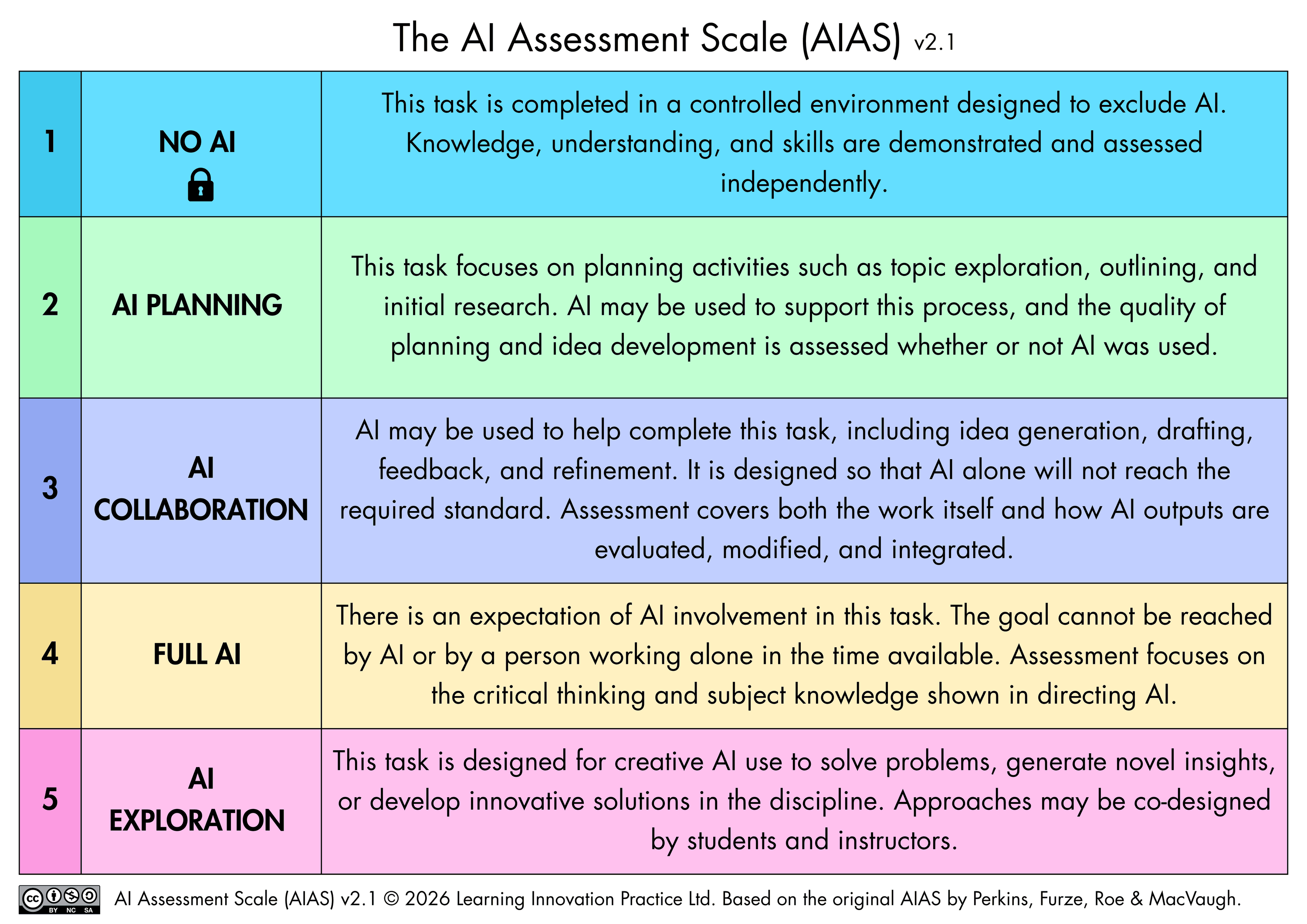
Each level describes a different kind of task, not a degree of permission. No level is better than another; the right one depends on what the task is meant to assess. Any level can be run under secure, supervised conditions if the task calls for it. Level 1 is the only level where those conditions are compulsory, and the padlock marks that.
An alternative view of the AIAS
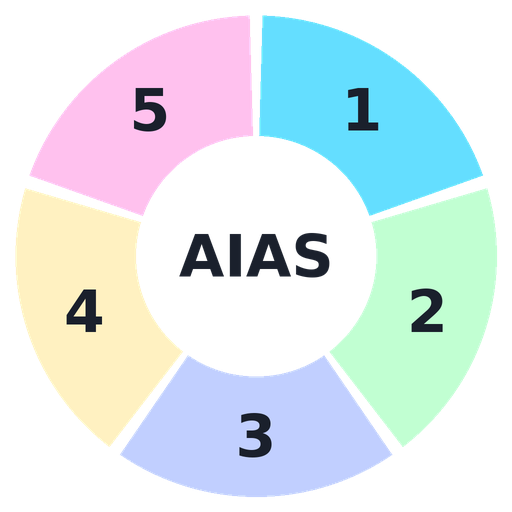
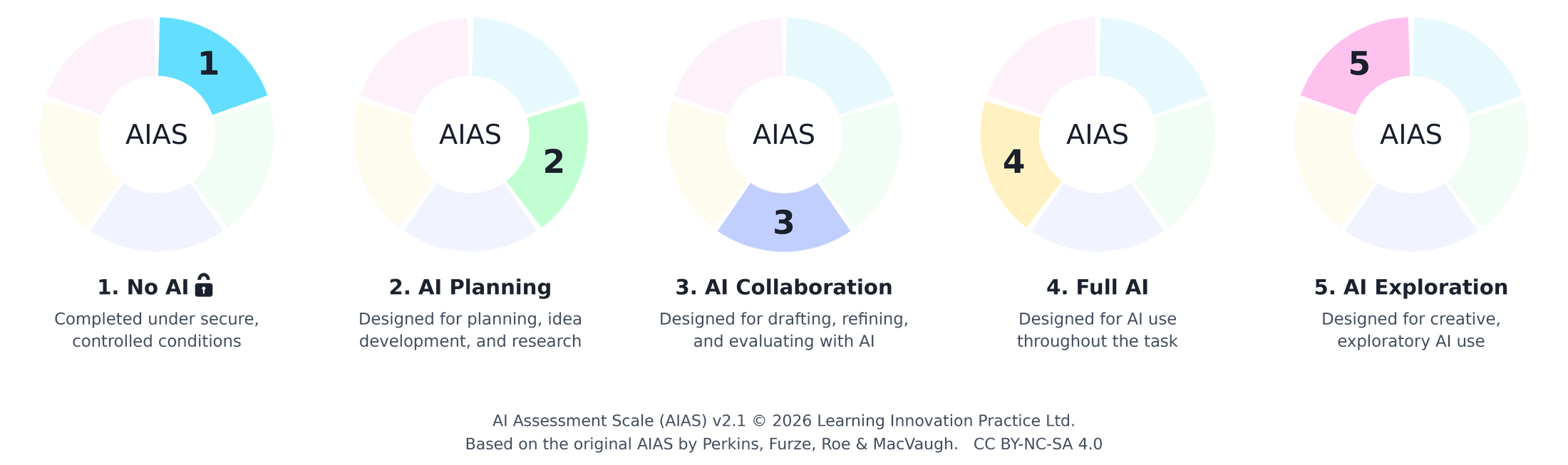
No one level of the AIAS is better or worse than another and any level can be used to support learning outcomes. Our assets also include the AIAS in a circular, non-hierarchical representation to emphasise that the levels are different kinds of task, not steps from worse to better.
What changed in AIAS 2.1?
One clear statement per level
The five levels of the scale are unchanged. Each level now has a single statement explaining how the task has been designed and what is expected of students. If you already use Version 2, your existing level choices remain applicable, but consider whether the revised wording suggests any changes to the design of the task.
Working on a specific task? New
The AIAS Custom GPT asks about your context, learning objectives, task, and constraints, then helps you pick a level, reword the brief, decide what evidence students should produce, and sketch rubric criteria.
Limited ChatGPT access? Use the Poe version.
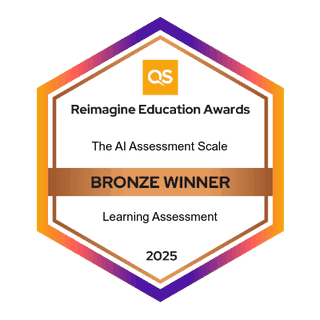
QS Reimagine Education Awards 2025 · Bronze Winner
Learning Assessment category
Implement the AIAS
Using the AIAS for task redesign
Choosing a level is only the start. The real work is redesigning the task so students know what evidence they need to produce, what AI use is expected or constrained, and how their work will be judged.
1
Start with learning
Clarify the learning outcomes, skills, and evidence the task should generate.
2
Choose the AI role
Decide whether AI should be excluded, used for planning, used collaboratively, integrated throughout, or explored creatively.
3
Redesign the evidence
Build in the process, artefacts, reflection, demonstration, or live elements needed to support valid assessment.
4
Align the rubric
Make the marking criteria reflect the intended AI use, student judgement, critical evaluation, and disciplinary standards.
Want guided support for this process?
The AIAS Custom GPT walks you through these steps for your own task, from choosing a level through to rubric ideas. Or read the full Implementation guide.
If your institution wants support with this work, Learning Innovation Practice runs assessment reviews, policy development, and staff workshops built around the AIAS. Get in touch.
Evidence base
Research papers
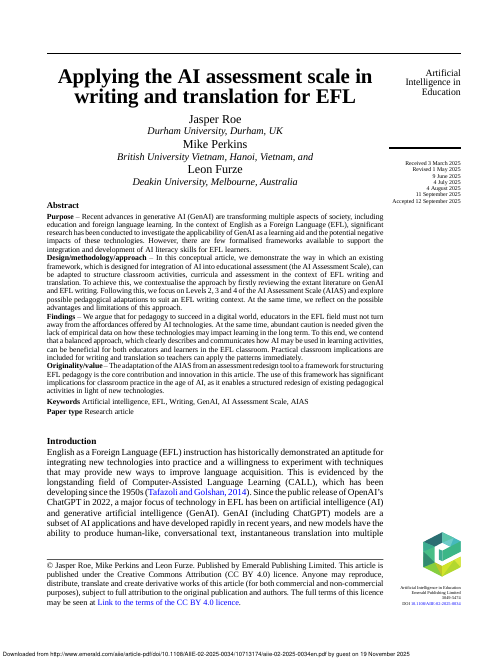
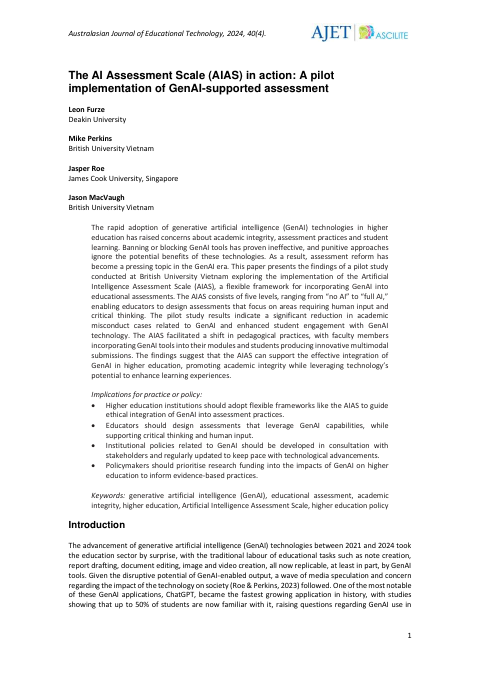
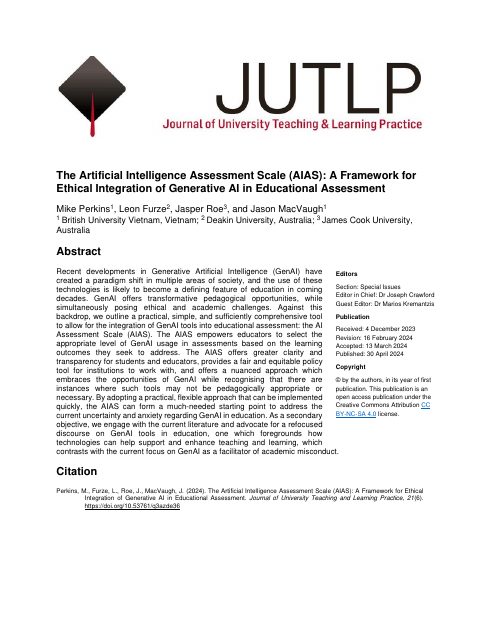
The AIAS research base covers the original framework, the revised assessment-redesign model, implementation studies, and language-context adaptations.
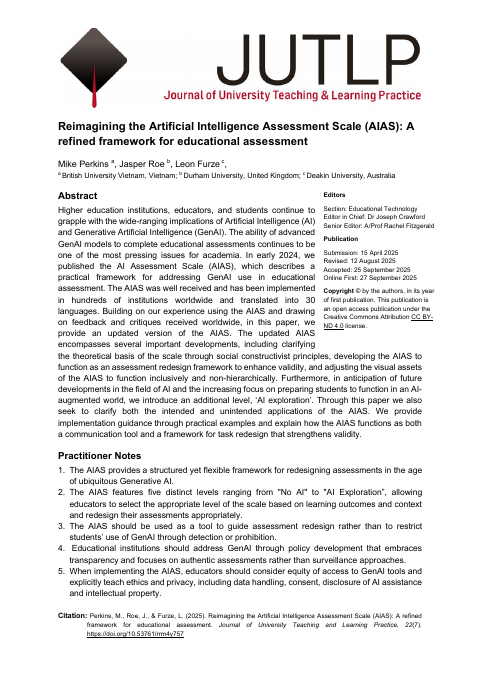
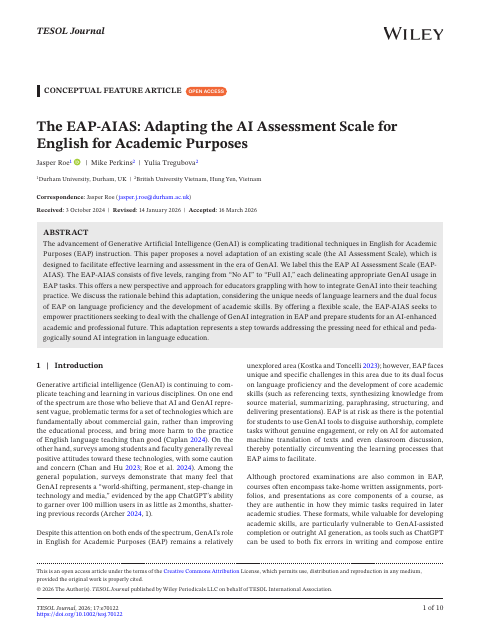
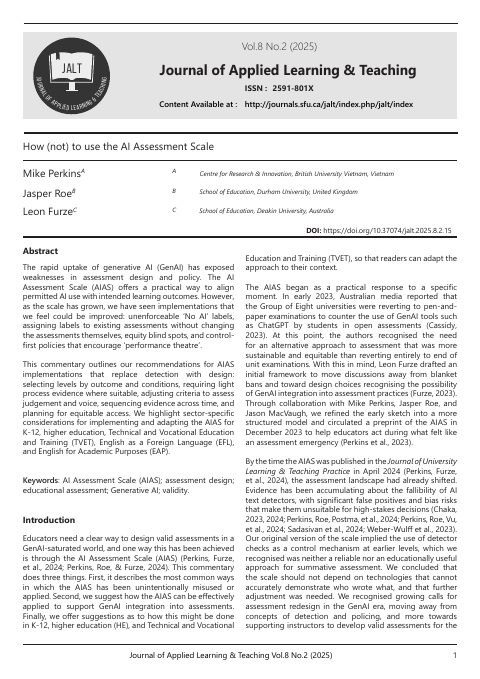
Open access
Resources
Downloads and templates
Download the grid as a PDF, PowerPoint or image, or open the editable template to adapt it for your own institution.
Translations
Thanks to our community, the AIAS is available in more than 30 languages. Read about the translations and find resources for each language here.
Custom AIAS GPT New
Rebuilt for AIAS 2.1 and now maintained by Learning Innovation Practice. A guided way to apply the AIAS to your own task: level selection, task wording, evidence, and rubric ideas.
Also available on Poe.
Contact
The AIAS was originally developed by Mike Perkins, Jasper Roe, Leon Furze and Jason MacVaugh, and is owned and maintained by Learning Innovation Practice Ltd. If you would like to share data on your implementation of the AIAS for an open repository, tell us how you are using it in your institution, or ask a question, please get in touch.