Research and publications
The research behind the AIAS: the original framework, the revised assessment-redesign model, implementation studies, and adaptations for specific language and disciplinary contexts.
Peer-reviewed papers
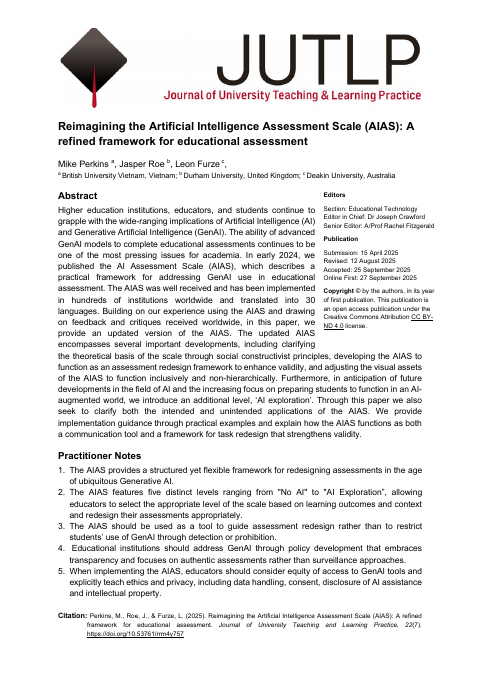
Current version · start here
Journal of University Teaching & Learning Practice, 22(7) · 2025
Reimagining the Artificial Intelligence Assessment Scale: A refined framework for educational assessment
Perkins, Roe & Furze. The revised model behind Version 2: repositioning the AIAS from a set of permissions to a framework for assessment redesign, informed by a year of worldwide implementation.
Read the paper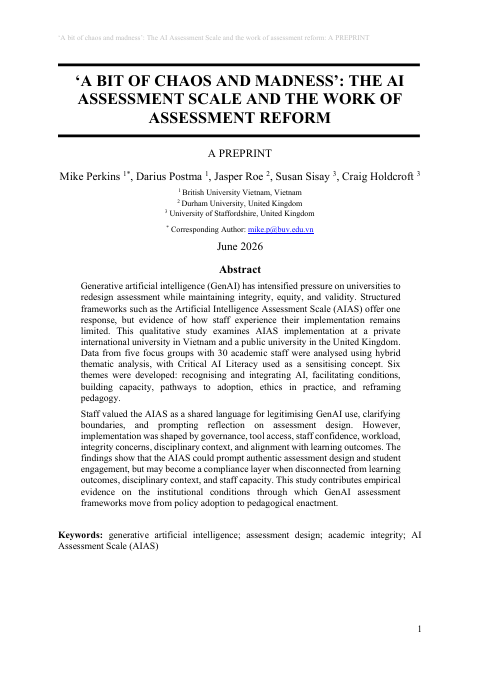
Assessment & Evaluation in Higher Education · published online 29 August 2026
‘A bit of chaos and madness’: The AI Assessment Scale and the work of assessment reform
Perkins, Postma, Roe, Sisay & Holdcroft. What implementing the AIAS actually demands of educators and institutions: the redesign labour, staff capacity, and organisational change behind assessment reform.
Read the paper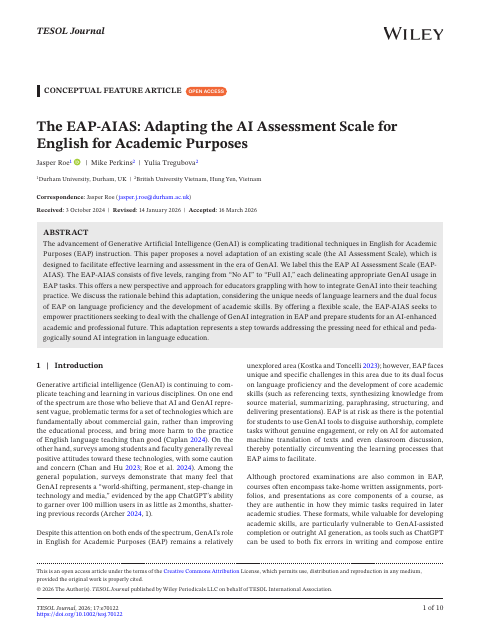
TESOL Journal · 2026
The EAP-AIAS: Adapting the AI Assessment Scale for English for Academic Purposes
Roe, Perkins & Tregubova. An adaptation of the AIAS for EAP contexts, where language development goals change what appropriate AI use looks like at each level.
Read the paper
Journal of Applied Learning & Teaching, 9(2) · 2026
Assessment twins: An approach for strengthening assessment validity in the age of generative AI
Roe, Perkins & Giray. Two deliberately linked components addressing the same learning outcomes through different kinds of evidence, scheduled close together so each can be read against the other. A practical way to pair an open task with a secured one.
Read the paper
Journal of Applied Learning & Teaching, 8(2) · 2025
How (not) to use the AI Assessment Scale
Perkins, Roe & Furze. Guidance on common implementation mistakes, including treating the levels as labels to attach to unchanged assessments rather than prompts for redesign.
Read the paper
Artificial Intelligence in Education (Emerald) · 2025
Applying the AI Assessment Scale in writing and translation for EFL
Roe, Perkins & Furze. A classroom application of the AIAS in English as a Foreign Language settings, focused on writing and translation tasks.
Read the paper
Australasian Journal of Educational Technology, 40(4) · 2024
The AI Assessment Scale (AIAS) in Action: A pilot implementation of GenAI-supported assessment
Furze, Perkins, Roe & MacVaugh. What happened when the AIAS was applied to real assessments, including effects on outcomes and academic misconduct cases.
Read the paper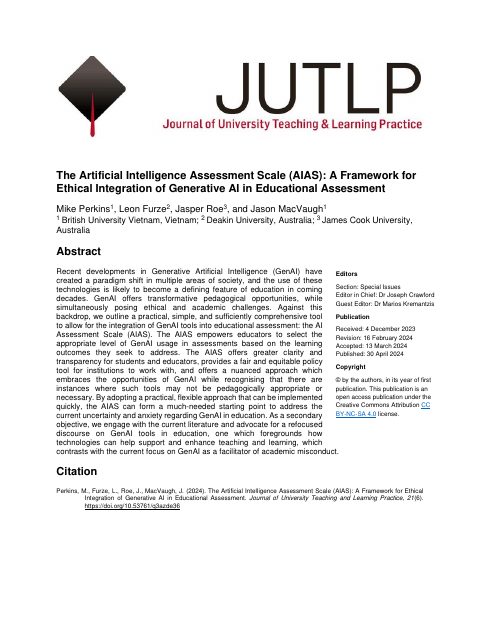
Journal of University Teaching & Learning Practice, 21(6) · 2024 · JUTLP Paper of the Year
The Artificial Intelligence Assessment Scale (AIAS): A framework for ethical integration of generative AI in educational assessment
Perkins, Furze, Roe & MacVaugh. The original framework paper: why assessment needed a shared language for AI use, and how the five levels support ethical integration.
Read the paper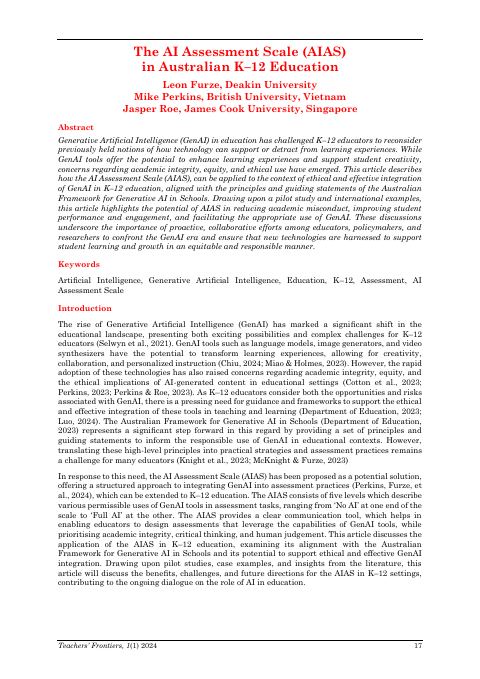
Teachers’ Frontiers, 1(1), 17–24 · 2024
The AI Assessment Scale (AIAS) in Australian K-12 Education
Furze, Perkins & Roe. Applying the AIAS in school contexts, where foundational skill development shapes how the levels are used.
Studying the AIAS?
If you have published research on the AIAS, or would like to share implementation data for an open repository, we’d like to hear from you.
Get in touch