Frequently asked questions
Common questions about the AI Assessment Scale, task redesign, and implementation.
Jump to section
Understanding the basics Version 2 to 2.1 Redesigning tasks Understanding the levels Detection and integrity
Understanding the basics
What is the AI Assessment Scale (AIAS)?
The AI Assessment Scale is a five-level framework for deciding what role AI should play in an assessment task, developed by Mike Perkins, Leon Furze, Jasper Roe, and Jason MacVaugh.
It does two jobs. As a communication tool, it gives educators clear language for telling students what a task expects. As a design framework, it guides the redesign of the task itself: the environment, the evidence students produce, and the marking criteria. It is grounded in Vygotskian social constructivism and the concept of the Zone of Proximal Development.
Where did the AIAS come from?
The AIAS was originally developed by Mike Perkins, Jasper Roe, Leon Furze and Jason MacVaugh in response to the rapid emergence of generative AI in education. GenAI tools were quickly becoming a normal part of working life outside education, but students and educators had no clear, fair, or practical basis for deciding when and how AI could be used in formative and summative tasks. Students were left guessing, and educators were left improvising rules task by task.
The Scale was created to give both groups a shared reference point. It has since grown from a communication tool into a framework for assessment redesign, used in more than 350 institutions worldwide.
What are the five levels of the AIAS?
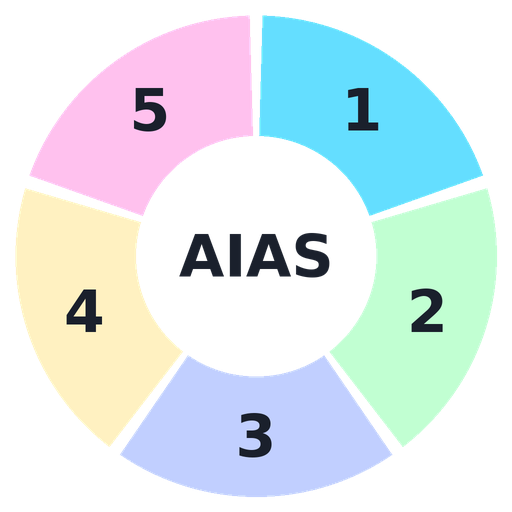
Level 1: No AI · Level 2: AI Planning · Level 3: AI Collaboration · Level 4: Full AI · Level 5: AI Exploration.
Important: the levels are non-hierarchical. Each one describes a different kind of task, not a degree of permission, and no level is better than another. The appropriate level depends on your learning outcomes, your context, and what the task is meant to assess.
Is the AIAS only an academic integrity tool?
No. Integrity is one outcome of using the AIAS well, but the framework’s main job is assessment redesign: aligning learning outcomes, task design, validity, marking criteria, and AI use so that a grade still means what it claims to mean.
If you approach the AIAS purely as a rulebook for catching misuse, you will get much less out of it than if you treat each level as a prompt to reconsider what the task asks students to do and what evidence it collects.
Is the AIAS prescriptive?
No. The levels are guiding rather than mandatory, and the student-facing wording is a starting point rather than a script. Designated AIAS diagrams and assets on the Resources page are licensed under CC BY-NC-SA 4.0 and may be reused for non-commercial educational purposes under the terms explained below.
Treat it as a basis for reform and conversation, and adapt it to your own teaching context.
Can I reuse this material?
Yes. The AIAS diagrams and designated assets shown on the Resources page are licensed under CC BY-NC-SA 4.0. Under that licence, they may be reused for non-commercial teaching, learning, assessment and other educational uses, provided that the attribution and copyright notices are retained.
The Creative Commons licence applies only to those designated resources. It does not apply to the website’s text, page content, design or other material, which may not be copied, republished, adapted or distributed without prior written permission, except where permitted by law.
Does the AIAS assume AI should be used in every task?
No. The learning objective always comes first. If AI use would undermine the skill or knowledge a task is meant to develop, Level 1 in a controlled environment is the right design choice, and the AIAS says so explicitly.
Having five levels does not mean spreading tasks evenly across them. Many programmes will use Level 1 heavily for foundational skills and reserve higher levels for tasks where working with AI is itself part of what is being assessed.
How does the AIAS relate to deciding whether an assessment is secured?
These are two separate decisions, and it helps to take them in order. First, can the environment be controlled? Second, what role should AI play in the task?
Deciding whether a task can be supervised tells you a great deal about what is enforceable, but it does not tell you how to design the task. Once you know the conditions, the levels give you language for the part that follows: whether the task is built around planning, collaboration, full integration or exploration, and what evidence and criteria each of those needs.
The padlock sits on Level 1 because it is the only level where secured conditions are compulsory. Any other level can be run under supervision if the task calls for it, so choosing a secure environment never obliges you to drop to Level 1.
What changed from Version 2 to 2.1
The five levels, their names, their order and their colours are unchanged. What changed is the wording and, at Levels 2, 3 and 4, the clearer indication of how the instructor has designed the assessment and what that design is intended to assess.
Version 2 gave each level two paragraphs: a description for educators, and a bold statement addressed to students. That second block was read as a rule to print onto an unchanged brief, which is the misuse we saw most often. Version 2.1 merges the two into one statement per level, written so it works for educators and students alike, and adds explicit design conditions at Levels 2, 3 and 4. Level 1 gained a padlock as the marker of the secured level.
1What changed at Level 1, No AI?
Version 2
The assessment is completed entirely without AI assistance in a controlled environment, ensuring that students rely solely on their existing knowledge, understanding, and skills.
You must not use AI at any point during the assessment. You must demonstrate your core skills and knowledge.
Version 2.1
This task is completed in a controlled environment designed to exclude AI. Knowledge, understanding, and skills are demonstrated and assessed independently.
Why it changed
The prohibition is now stated as a property of the environment rather than an instruction to the student. “Designed to exclude AI” puts the obligation on whoever sets the task: if you cannot assure AI-free conditions, this is not Level 1. The padlock was added because Level 1 is the only level that has to run under secured conditions.
2What changed at Level 2, AI Planning?
Version 2
AI may be used for pre-task activities such as brainstorming, outlining and initial research. This level focuses on the effective use of AI for planning, synthesis, and ideation, but assessments should emphasise the ability to develop and refine these ideas independently.
You may use AI for planning, idea development, and research. Your final submission should show how you have developed and refined these ideas.
Version 2.1
This task focuses on planning activities such as topic exploration, outlining, and initial research. AI may be used to support this process, and the quality of planning and idea development is assessed whether or not AI was used.
Why it changed
“Whether or not AI was used” is the substantive addition, drawn from the storyboard vignette in the 2025 JUTLP paper. It resolves the most common objection to Level 2: that planning can be outsourced to AI in an unsupervised setting. The level does not depend on policing that, because the quality of the planning is what gets marked either way. “Topic exploration” replaced “brainstorming” to work more clearly across a wider range of subjects and settings, where the activity may look nothing like a brainstorm.
3What changed at Level 3, AI Collaboration?
Version 2
AI may be used to help complete the task, including idea generation, drafting, feedback, and refinement. Students should critically evaluate and modify the AI suggested outputs, demonstrating their understanding.
You may use AI to assist with specific tasks such as drafting text, refining and evaluating your work. You must critically evaluate and modify any AI-generated content you use.
Version 2.1
AI may be used to help complete this task, including idea generation, drafting, feedback, and refinement. It is designed so that AI alone will not reach the required standard. Assessment covers both the work itself and how AI outputs are evaluated, modified, and integrated.
Why it changed
The most substantive change of the five. Neither Version 2 block said the work itself was assessed, which fed the “are you just marking the AI?” objection. Two commitments are now explicit. First, the task is built so that unedited AI output falls short — a claim about design, not about model capability, and testable by running the brief through a model and marking the result. Second, assessment covers the work and the handling of AI output, so a rubric needs criteria for both. The requirement to maintain “your own voice” was also removed from the statement, because it does not travel across disciplines: it is a meaningful construct in an essay and close to meaningless in a laboratory write-up, which is the example we use for Level 3 in our own published work. Where voice matters in your discipline, name it in your criteria.
4What changed at Level 4, Full AI?
Version 2
AI may be used to complete any elements of the task, with students directing AI to achieve the assessment goals. Assessments at this level may also require engagement with AI to achieve goals and solve problems.
You may use AI extensively throughout your work either as you wish, or as specifically directed in your assessment. Focus on directing AI to achieve your goals while demonstrating your critical thinking.
Version 2.1
There is an expectation of AI involvement in this task. The goal cannot be reached by AI or by a person working alone in the time available. Assessment focuses on the critical thinking and subject knowledge shown in directing AI.
Why it changed
Two changes. The task now has a difficulty condition attached: the goal must be out of reach for AI alone and for a person alone in the time available. That is what stops Level 4 becoming “submit whatever the model produced”. And the assessed object moved from how effectively AI was integrated to the critical thinking and subject knowledge behind the direction, so orchestration is the evidence rather than the thing being marked.
5What changed at Level 5, AI Exploration?
Version 2
AI is used creatively to enhance problem-solving, generate novel insights, or develop innovative solutions to solve problems. Students and educators co-design assessments to explore unique AI applications within the field of study.
You should use AI creatively to solve the task, potentially co-designing new approaches with your instructor.
Version 2.1
This task is designed for creative AI use to solve problems, generate novel insights, or develop innovative solutions in the discipline. Approaches may be co-designed by students and instructors.
Why it changed
Essentially a straight merge. The two Version 2 blocks said almost the same thing here, so nothing needed preserving. Co-design already implies the design condition, so no further clause was needed, and “may be” replaced the implied requirement to co-design.
Redesigning tasks with the AIAS
How do I redesign a task using the AIAS?
Work through four steps:
- Start with learning. Clarify the learning outcomes and the evidence the task should generate.
- Choose the AI role. Decide whether AI should be excluded, used for planning, used collaboratively, integrated throughout, or explored creatively.
- Redesign the evidence. Build in the process, artefacts, reflection, demonstration, or live elements needed to assess validly at that level.
- Align the rubric. Make the marking criteria reflect the intended AI use, student judgement, and disciplinary standards.
For a guided version of this process, use the AIAS Custom GPT. It asks about your context, learning objectives, task, and constraints, then helps with level selection, task wording, evidence, and rubric ideas. The Implementation guide covers the full process in detail.
Can I just label my existing assessments with AIAS levels?
This is the most common implementation mistake. Adding a level label to an unchanged task is what Corbin, Dawson and Liu (2025) call a discursive change: the wording moves, the task does not. Students tend to ignore labels that don’t match what the task actually requires.
Effective implementation needs structural change:
- Redesign the assessment brief to match your chosen level
- Update rubrics to reflect the intended AI use
- Specify what evidence students must provide
- Create checkpoints that align with the level’s expectations
How do I choose between Levels 2, 3, 4, and 5?
Ask what the task is actually assessing, because each level assesses something different:
- Level 2 assesses how students develop and refine ideas from a starting point. AI may help generate that starting point; the assessed work is what students build from it.
- Level 3 assesses judgement: how students evaluate, modify, and take ownership of work produced with AI assistance, keeping their own voice.
- Level 4 assesses direction: how effectively students orchestrate AI to reach a goal, and the quality of what they produce together.
- Level 5 assesses novel application: using AI in ways that push at the boundaries of the discipline, often co-designed with the educator.
Then sanity-check the choice: would the assessment still be valid if AI were used more than you intend? Can you realistically support the design? Do all students have equitable access to the tools? How does the task fit the wider programme?
If you want to talk this through for a specific task, the AIAS Custom GPT is built for exactly that conversation.
What do I assess at Levels 2, 3, 4, and 5?
Once AI can contribute to the product, the product alone is weaker evidence. Shift some of the assessment weight onto things AI cannot supply on a student’s behalf:
- Process evidence: drafts, planning documents, prompt logs, version history
- Judgement: what students kept, changed, or rejected from AI output, and why
- Application to context: local data, personal experience, class-specific material
- Live performance: presentations, vivas, demonstrations, in-class writing
- Reflection: short accounts of how AI was used and what the student learned
Your rubric should name these explicitly. If the criteria only describe the finished product, students will read that as a signal that process doesn’t matter.
Can a Level 2 task lead into another assessment?
Yes, and it often works better that way than as a whole assessment on its own. Earlier versions of the level said so explicitly, and although that clause has gone from the statement, the practice still holds.
A common sequence: students do the planning at home, where AI may support their topic exploration and outlining, and you assess the quality of that planning. The work that follows then sits at a different level. It might be an in-class piece under supervised conditions, which puts it at Level 1, or a piece of homework where AI use is expected, which puts it at Level 3, 4 or 5 depending on what you want to assess.
This works because the AIAS applies to individual tasks, not to whole modules or units. One assessment brief can contain several tasks at different levels, and often should. Use that flexibility: it lets you assess planning and finished work separately, and gives you a secured component alongside an open one without having to make the whole assessment secure.
How does the AIAS work for assessment for learning?
The name puts the emphasis on assessment of learning, but the levels describe kinds of task, and they are at their most useful in assessment for learning. This is where a level can be chosen to develop something rather than to certify it.
School settings show this most clearly, because students work through a sequence of tasks with the same teacher over weeks rather than submitting one graded piece. That gives you room to vary the level deliberately: run the same activity at Level 2 and Level 4 and talk about the difference; use a Level 3 activity to teach evaluation of AI output directly; use Level 2 to practise turning an AI-generated starting point into something of the student’s own while nothing rides on it.
These tasks are also where students build the AI literacy that graded work later assumes. A summative task at Level 3 or 4 expects critical, skilled use, and students need low-stakes practice to get there. Choosing levels across a teaching sequence, rather than only at the point of grading, is how most of the benefit is realised.
How should I handle equity and access issues?
If a task involves AI, equity has to be part of the design:
- If your task requires GenAI tools, you must ensure all students have free access to appropriate tools
- Consider institutional subscriptions, or design around freely available resources
- Be transparent about which tools are permitted
- Distinguish between AI tools and assistive technologies; students requiring assistive technologies should not be disadvantaged
Students also arrive with very different levels of AI literacy. Build in support and guidance rather than assuming prior knowledge.
Should AI policies be consistent across a programme?
Yes. We strongly recommend standardising AIAS implementation within modules and across programmes. Inconsistent policies create:
- Validity issues when similar tasks have different rules
- Student confusion about expectations
- Difficulties in programme-level assessment mapping
Work at the faculty or discipline level to ensure coherent implementation. This “leading from the middle” approach has proven more effective than either top-down mandates or individual instructor decisions.
Understanding the levels
Can I use “No AI” (Level 1) for take-home assignments?
No. This is a common misconception. There is no realistic way to ensure students avoid AI in unsecured environments, so Level 1 should only be used where you can genuinely enforce the restriction:
- Supervised examinations
- In-class assessments with device restrictions
- Oral examinations or vivas
- Observed practical demonstrations
For take-home work, choose Levels 2–5 and design the task structurally for that level instead.
What does the padlock mean, and can any level be run securely?
The padlock marks Level 1 because it is the only level that has to run under secured conditions. A No-AI task holds up only where AI-free conditions can genuinely be assured, so that requirement is built into what Level 1 means.
Any other level can also be run under supervision where that suits the task. A Level 4 task on locked-down lab machines, with students directing approved tools under invigilation, is a perfectly coherent design. Wanting a secured task never obliges you to drop to Level 1.
Deciding the conditions and deciding the role of AI are separate steps. The conditions tell you what is enforceable; the level tells you what the task is built to assess.
How can Level 2 work if planning can be “outsourced” to AI?
This question usually comes from reading Level 2 as a rule (“AI is allowed for planning only”) rather than as a task type. In an unsupervised environment, you cannot police where AI use stops. What you can control is what the task assesses.
A Level 2 task is designed so that the assessed work is what students do after the planning stage: how they develop, refine, and take an idea somewhere the AI-generated starting point did not go. The submission should make that development visible, through drafts, annotated outlines, or a short account of how the initial ideas changed.
If the planning itself is the learning outcome you need to assess, Level 2 in an uncontrolled setting is the wrong choice. Put that element into a supervised task instead, or change what evidence you collect.
What is the difference between Level 3 and Level 4?
Level 3 (AI Collaboration): AI assists with specific, defined parts of the task. Students critically evaluate and modify AI outputs, drive the work, and keep their own voice. Think of AI as a collaborator on particular elements.
Level 4 (Full AI): AI may contribute to any part of the task, and its involvement is expected. Students direct and orchestrate AI to achieve their goals, and the assessment evaluates how effectively they do so. Think of AI as a capable assistant the student manages.
Does Level 4 require students to use AI?
Level 4 is designed around an expectation of AI involvement. This can be addressed in two main ways:
- AI use is explicitly required. The task may require students to use a particular AI system, submit AI-generated outputs, or demonstrate and evaluate their interaction with AI. In this case, AI use is a formal requirement of the assessment.
- AI use is necessary in practice. The task may technically be possible without AI, but its scope, complexity or available time means that completing it to the intended standard without AI would be impractical. AI use is therefore expected, although it may not be expressed as an absolute rule.
Both approaches can be appropriate at Level 4. The instructor should make the intended approach clear in the assessment instructions.
Is the AIAS level all I should give students to explain what is expected?
No. The AIAS level is a starting point for communicating expectations, not the end point.
The level establishes the general role AI should play in the task. Accompanying instructions or the formal assessment brief should then explain what this means in practice, including whether AI use is required or optional, which tools and activities are permitted, what evidence students should provide, and how their use of AI will be assessed.
What does “maintaining your own voice” mean in practice?
At Level 3, the student remains the author. The argument, position, judgements, and choice of examples should be theirs, even where AI helped with drafting or refinement. A submission where the student cannot explain or defend what it says has lost its voice, however polished it reads.
In practical terms, students maintain their voice when they rework AI output rather than accept it, disagree with suggestions that don’t fit their argument, and bring in material AI could not know: their own experience, local context, class discussion, specific sources.
For educators, this is a design and rubric question. Ask for the elements above in the brief, put criteria for argument and judgement in the rubric, and consider a short viva or reflection where students account for their choices.
When should I use Level 5 (AI Exploration)?
Level 5 suits advanced contexts where students are pushing at the boundaries of AI application:
- Advanced undergraduate projects
- Postgraduate coursework
- Doctoral research
- Independent projects at the cutting edge of a discipline
At this level, students conceptualise and implement novel AI applications, and the educator becomes more of a collaborator than an assessor. Examples include developing custom AI tools, creating bespoke datasets, or building AI-enhanced solutions to real problems.
Why did Version 2 remove the traffic light colours?
The original AIAS used red-amber-green colours, which created unintended problems:
- It implied a hierarchy where “green” levels were better than “red” levels, contradicting the non-hierarchical design principle
- It created accessibility issues for colour-blind users
Version 2 uses a circular representation instead, which emphasises that the levels are different kinds of task rather than better or worse ones.
Detection and academic integrity
Should I use AI detection tools to enforce AIAS levels?
We do not recommend using AI detection tools for summative assessment decisions. Current tools have significant limitations:
- High rates of false positives, particularly for non-native English speakers
- Easily bypassed with simple paraphrasing or editing
- Risk of severe consequences for falsely accused students
- An adversarial dynamic between students and educators
Our recommendation: replace detection with design. Structure your assessments so that appropriate AI use is built into the task rather than policed after submission.
How can I maintain academic integrity without detection tools?
- Controlled environments: use Level 1 only where you can genuinely secure the assessment
- Build evidence over time: use multiple assessment points at various levels (the “Swiss cheese” approach), or pair two linked tasks as assessment twins so that each can be read against the other
- Require process evidence: prompt logs, drafts, or reflections at Levels 2–4
- Include oral components: brief vivas or presentations where students explain their work
- Design tasks that reveal thinking: personal reflection, local context, or novel application
- Be transparent: clear communication about expectations reduces misunderstanding
Should students disclose their AI use?
Transparency is valuable, but research shows students are often reluctant to disclose AI use even when it is permitted. Rather than relying solely on disclosure:
- Design assessments where AI use becomes visible through the task structure itself
- Require brief process evidence at Levels 2–4, framed as professional practice rather than a “gotcha”
- Frame disclosure as developing professional skills, not surveillance
- Teach critical AI literacy so students understand why transparency matters
If you want to set expectations with a class explicitly, or work up a course-level policy on AI use, AI Disclose is a third-party tool built on the AIAS that walks through those decisions with you.
What about students using AI when it is not permitted?
This is precisely why Level 1 should only be used in controlled environments. In unsecured settings, some students will use AI regardless of the rules, which makes those rules unenforceable and creates validity problems. The answer is better design:
- Only prohibit AI where you can genuinely enforce the prohibition
- For unsecured work, choose Levels 2–5 and design accordingly
- Build structural features that make inappropriate use difficult or obvious
- Use multiple assessment points rather than single high-stakes submissions, or pair two linked tasks as assessment twins, so that each can be read against the other
Still have questions?
For task-specific help, try the AIAS Custom GPT. For anything else, get in touch with the team.
Contact us